
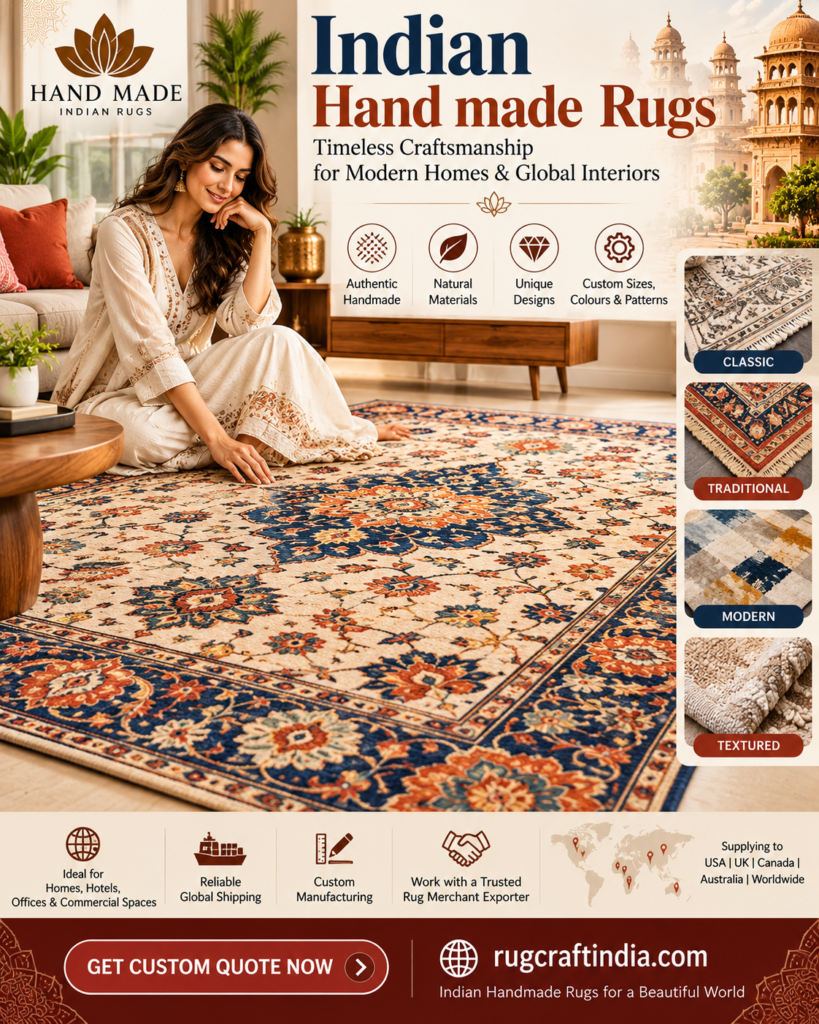
Indian Hand made rugs: Where Heritage Meets Modern Living
A beautiful rug can completely transform an interior. It can add warmth, define a seating area, introduce colour, create texture, and give a room a distinctive personality. But some rugs offer much more than decoration. Indian Hand made rugs combine traditional craftsmanship, artistic expression, natural materials, and contemporary design to create pieces that can become an important part of an interior.
India has developed a remarkable rug-making tradition over centuries. Traditional techniques have evolved alongside changing interior-design preferences, allowing Indian artisans to create rugs suitable for luxury residences, boutique hotels, designer spaces, offices, and modern homes around the world.For international buyers, sourcing from India also opens access to a diverse range of materials, construction techniques, regional traditions, designs, colours, and custom-made possibilities.
Why Indian Hand made rugs Are Special
A machine-made carpet can reproduce the same design thousands of times. A handmade rug, however, depends on human skill and countless individual decisions involving fibre, colour, pattern, knotting, weaving, texture, and finishing.
Artisans may spend weeks or months creating a single rug, particularly when the design is intricate or the dimensions are large. Small variations between pieces are therefore natural and can be part of the character of handmade craftsmanship.
This individuality is one reason Indian Hand made rugs have become attractive to buyers looking for authentic products rather than completely uniform mass-produced flooring.
Behind every rug is a process involving people, materials, knowledge, patience, and craftsmanship.
Indian Handmade rugs and India’s Rich Craft Tradition
The history of Indian carpet making extends back more than 500 years. Persian knotting techniques were introduced during the Mughal period, but Indian artisans gradually adapted those techniques to local culture, architecture, nature, flora, fauna, and spiritual influences.The result was not simply a copy of Persian carpet traditions. Indian rug-making developed its own distinctive identity.
Today, buyers can explore different regional traditions across India, each offering different visual and technical possibilities.
Kashmir
Kashmiri rugs are particularly associated with fine silk fibres, intricate floral patterns, high knot density, soft finishes, and detailed craftsmanship.For interiors where elegance and visual richness are important, Kashmir-inspired rugs can provide a sophisticated decorative statement
Bhadohi
Bhadohi is an important carpet-producing region known for dense knotting, large luxury carpets, contemporary designs, export-oriented production, and designer collaborations.This makes the region particularly interesting for larger residential and commercial requirements.
Jaipur
Jaipur combines traditional skills with contemporary design. Buyers can find geometric patterns, abstract compositions, minimalist aesthetics, contemporary textures, and palace-inspired influences.
Agra
Agra continues to reflect Mughal-era influences through floral arrangements, medallions, Persian-inspired borders, earthy colours, and architectural motifs.
For international buyers, this regional diversity means that “Indian rug” is not one single design category. It represents a broad collection of artistic traditions.
Indian Hand made rugs: Choosing the Right Material
Material should be one of the first considerations when selecting a handmade rug.
Different fibres produce different levels of softness, durability, texture, sheen, and resilience. The best material therefore depends on the room, application, desired appearance, traffic level, and maintenance expectations.
The source article identifies several materials used in Indian rug production, including Indian and New Zealand wool, Kashmiri silk, bamboo silk, cotton, jute, hemp, and viscose.
Wool
Wool is a popular choice when strength, comfort, warmth, and everyday usability are important.
Silk can provide exceptional visual richness and an elegant appearance, making it suitable for interiors where luxury and fine detail are priorities.
Jute
Jute can create a natural, organic appearance and works particularly well with earthy and relaxed interior concepts.
Cotton
Cotton provides a lighter and more casual option and can be suitable for selected residential applications.
The important point is simple: do not select the material only because a rug looks attractive in a photograph.
Consider where the rug will be used and what performance you expect from it.
Indian Hand made rugs: Understanding the Craftsmanship
The construction method significantly influences the character and value of a handmade rug.
Hand-knotting involves creating individual knots manually. Hand-tufting and handloom weaving use different processes and can produce different textures and visual effects.
Highly detailed or oversized rugs can require substantial time and skilled labour.
When evaluating Indian Hand made rugs, therefore, look beyond the visible pattern.
Ask:
- How was the rug constructed?
- Which fibre was used?
- What type of knotting or weaving technique was used?
- How detailed is the design?
- What finishing process was followed?
- Is the construction appropriate for the intended room?
Understanding craftsmanship allows buyers to make decisions based on more than appearance alone.
Indian Hand made rugs: Explore Modern Design Trends
Traditional Indian craftsmanship is increasingly being adapted for contemporary interiors.
For 2026, several design directions highlighted in the source article are particularly relevant.
Natural Colours and Organic Textures
Beige, ivory, taupe, olive, sand, and warm brown can create understated interiors.
Natural-looking fibres and textures can add warmth without overwhelming minimalist spaces.
Sculpted and Textured Rugs
High-low pile construction, carved details, layered surfaces, and three-dimensional textures can add depth to an otherwise simple interior.
Abstract and Geometric Designs
Abstract artwork, asymmetrical lines, and geometric shapes can turn a rug into an artistic focal point.
These designs are particularly useful in contemporary open-plan living and dining spaces.
Traditional motifs can be refreshed with muted blue, terracotta, sage green, ivory, and charcoal.
This approach allows buyers to introduce Indian design heritage into contemporary interiors without creating an overly traditional appearance.
Indian Hand made rugs: Choose the Correct Size
Rug size can dramatically affect the appearance of a room.
One common mistake is selecting a rug that is too small. A properly sized rug can visually connect furniture and create a cohesive composition.
Oversized rugs are particularly useful in large open-plan spaces because they can help connect sofas, chairs, tables, and other furniture into a unified arrangement.
Before ordering, carefully measure the room and consider the furniture layout.
For unusually shaped rooms or specific interior projects, custom sizing can be an excellent solution.
Indian Hand made rugs: Consider Custom Designs
One of the major advantages of working with Indian rug suppliers is the possibility of customization.
Custom handmade rugs can be developed around specific:
- Dimensions
- Shapes
- Colours
- Patterns
- Materials
- Interior concepts
- Commercial requirements
This makes custom rugs particularly valuable for interior designers, architects, hotels, hospitality projects, luxury residences, and commercial spaces.
Instead of changing the room to accommodate an available rug, you can explore a rug designed around the room.
For international buyers, this can be especially useful when standard retail dimensions do not meet project requirements.
Indian Hand made rugs: Sustainability and Responsible Craft
Today’s buyers increasingly want to understand the story behind the products they purchase. The source article highlights growing interest in natural fibres, ethical production, recycled cotton, plant-based dyes, and responsible artisan production.Long-lasting handmade products may also reduce the need for frequent replacement. Supporting traditional craftsmanship can help preserve valuable artisan skills and provide livelihoods for craft communities.
For buyers interested in conscious interiors, the combination of craftsmanship, natural materials, longevity, and responsible production can make handmade rugs an attractive option.However, international buyers should always ask suppliers specific questions about materials, production practices, certifications, and sustainability claims rather than assuming that every handmade rug automatically meets a particular sustainability standard.
Indian Hand made rugs: Think About Long-Term Value
Price is important, but it should not be the only consideration.
A high-quality handmade rug represents craftsmanship, materials, labour, individuality, and time. With appropriate care, quality handmade rugs can potentially remain useful and attractive for many years.
Therefore, instead of asking only:
“How much does this rug cost?”
also ask:
“What value can this rug provide over its lifetime?”
Durability, timeless design, craftsmanship, suitability for the space, and long-term usability should all form part of the buying decision.
Indian Hand made rugs: Follow a Smart Buying Process
A structured buying process can make rug selection easier.
Step 1: Measure Your Space
Record the room dimensions before selecting the rug.
Step 2: Study the Furniture
Consider how sofas, chairs, tables, beds, and other furniture will interact with the rug.
Step 3: Select the Material
Consider comfort, durability, appearance, traffic, and maintenance requirements.
Step 4: Define Your Design Style
Decide whether you prefer:
• Minimalist
• Traditional
• Geometric
• Abstract
• Heritage-inspired
• Textured
• Natural and earthy
• Luxurious and decorative
Step 5: Decide Between Standard and Custom
If your space has unusual dimensions or you have a specific design concept, custom production may provide greater flexibility.
Step 6: Understand the Craftsmanship
Ask about construction, material, production method, finishing, and maintenance.
Step 7: Think Beyond Current Trends
A rug should ideally complement your interior for years rather than becoming obsolete after one design season.
This step-by-step approach can help buyers make more confident decisions.
Why Buy Indian Hand made rugs Through a Merchant Exporter?
International buyers often face challenges when sourcing directly from an unfamiliar market.
Finding suitable manufacturers, comparing materials, understanding construction methods, discussing customization, communicating project requirements, and coordinating international orders can take considerable time.
This is where a merchant exporter can become a valuable sourcing partner.
At RugCraft India, we help international buyers explore Indian rug manufacturing and connect their requirements with suitable Indian manufacturers and artisan production capabilities.
We are not a rug manufacturer. Our role is to help buyers identify suitable Indian sourcing options according to their project requirements.
We can help buyers looking for:
• Handmade wool rugs
• Silk and luxury rugs
• Cotton rugs
• Jute and natural-fibre rugs
• Hand-knotted rugs
• Hand-tufted rugs
• Handwoven rugs
• Custom-size rugs
• Custom-colour rugs
• Custom-design rugs
• Hospitality rugs
• Large residential rugs
• Hotel and resort rugs
• Interior-design project requirements
Whether you are an interior designer, architect, hotel procurement professional, importer, wholesaler, retailer, or luxury-home buyer, we can help you explore suitable Indian sourcing opportunities.
Source Indian Hand made rugs From India With Confidence
The right rug is more than a floor covering.
It can become the foundation of a room’s personality, introduce craftsmanship into a modern interior, connect furniture into a cohesive composition, and carry a story of Indian artistic tradition into homes and commercial spaces around the world.
Indian Hand made rugs offer an exceptional combination of heritage, craftsmanship, material diversity, contemporary design, customization, and individuality.
But choosing the right rug requires more than simply selecting a beautiful photograph.
You need to consider the material, construction, size, design, colour, application, customization requirements, quality expectations, and supplier capability.
Ready to Source Indian Hand made rugs for Your International Project?
Looking for authentic Indian rugs for your home, hotel, resort, interior-design project, or retail business?
RugCraft India can help you connect with suitable Indian rug manufacturers and artisan production sources based on your requirements.
Your Vision. Indian Craftsmanship. Our Merchant Export Sourcing Connection.
Source from India. Discover Indian craftsmanship. Build your global rug collection with RugCraft India.
Explore our website: rugcraftindia.com
Pingback: Indian Hand made rugs for hotels: A Complete Guide to Choosing Luxury Hotel Rugs
Pingback: Right Rug Size for Your Home: A Practical Room-by-Room Guide
Pingback: Indian Hand made rugs for hotels: Sourcing, Customization and Design Strategy
Pingback: Handmade Rugs for Executive Offices: Transforming Professional Spaces with Indian Craftsmanship